
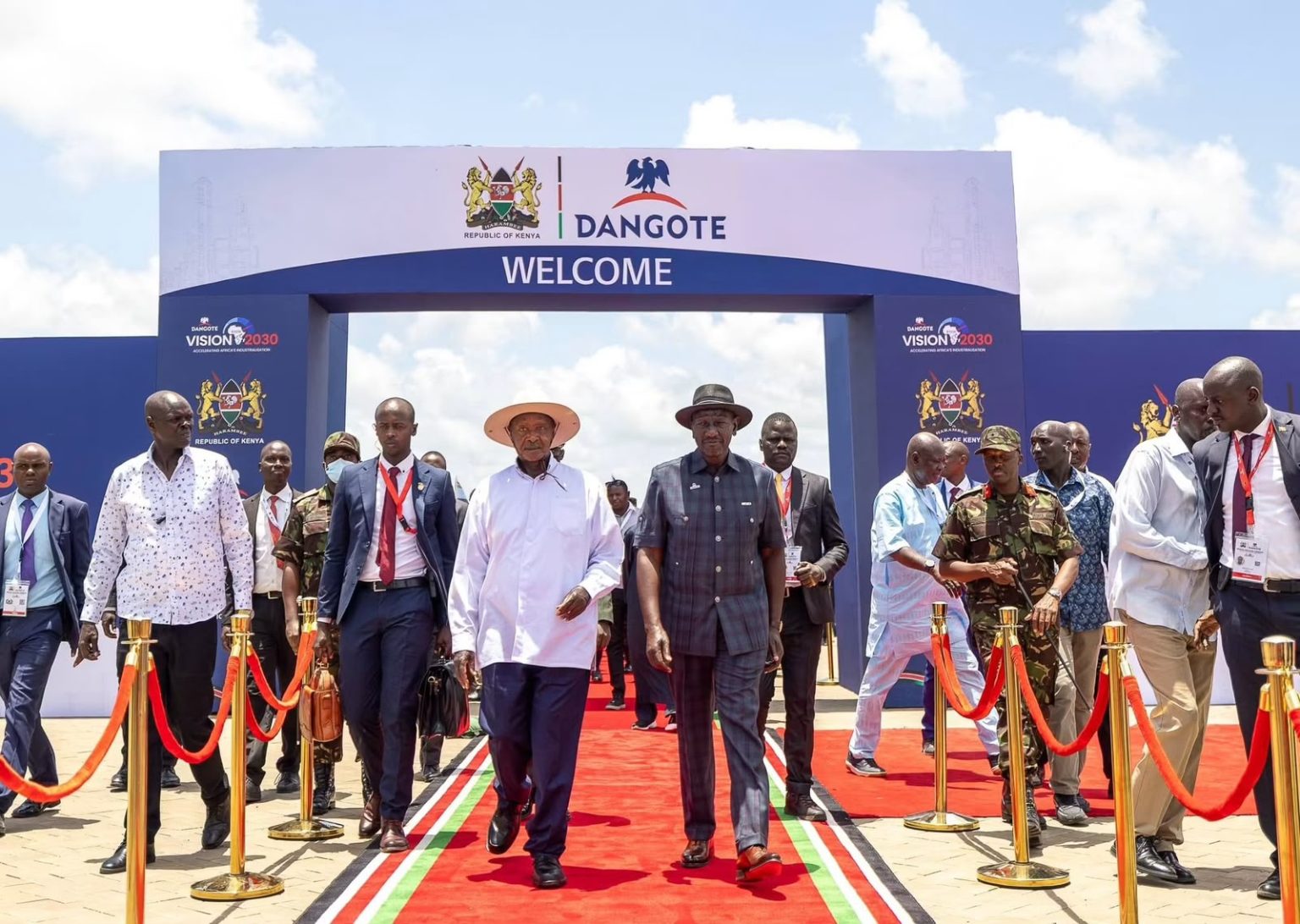

Ruto, African leaders break ground for 700,000-barrel-a-day Lamu refinery as East Africa makes a major push for energy security and industrialisation
By Ìjáàlí Online News | September 30, 2026
| INVESTMENT | CAPACITY | TARGET | POWER |
| $16 billion | 700,000 bpd | Around 2030 | Up to 1,000 MW |
LAMU, KENYA — Nigerian industrialist Aliko Dangote and Kenyan President William Ruto on Wednesday formally broke ground on a $16 billion oil refinery in Lamu, launching one of Africa’s most ambitious private industrial projects and a development that could reshape petroleum supply across East Africa.
The proposed refinery is designed to process about 700,000 barrels of crude oil per day when fully operational. The project is expected to take roughly 40 months to build, with completion targeted around 2030. At the announced investment value, it would rank among the largest foreign direct investments in Kenya’s history.
The refinery is also planned as more than a fuel-processing plant. The wider complex is expected to include power generation of up to 1,000 megawatts, major storage and logistics infrastructure, and links to the expanding Lamu port and transport corridor.
For Kenya and its neighbours, the ceremony represented a bet that East Africa can refine a much larger share of the petroleum products it consumes rather than remain heavily dependent on imports of finished fuels.
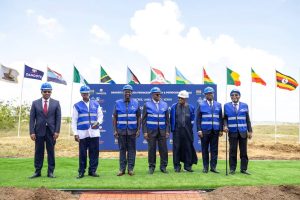
AFRICAN LEADERS GATHER IN LAMU
The groundbreaking brought together senior political figures from across Africa. President Ruto hosted visiting leaders and dignitaries, including Ugandan President Yoweri Museveni and Ethiopian Prime Minister Abiy Ahmed, while former Nigerian President Olusegun Obasanjo was also reported among those attending.
Their presence reflected the regional ambitions attached to the refinery. Dangote’s plan is not limited to supplying Kenya. The facility is intended to serve markets across East Africa and potentially farther south, creating a new petroleum-processing centre on the Indian Ocean coast.
The project also places a Nigerian-owned industrial group at the centre of one of East Africa’s biggest infrastructure investments, underscoring the growing role of African private capital in cross-border development.
WHY LAMU MATTERS
Lamu’s selection is strategic. The county hosts Kenya’s deep-water Lamu Port and sits at the heart of the Lamu Port-South Sudan-Ethiopia Transport Corridor, widely known as LAPSSET. The corridor was conceived to connect the Kenyan coast with inland markets and neighbouring economies through ports, roads, pipelines and other infrastructure.
The refinery had earlier been considered for Tanga in Tanzania before Lamu emerged as the preferred location, with deep-water access and site conditions among the factors cited in reporting on the project.
Heavy equipment has already begun arriving through Lamu Port. Kenya’s maritime authorities said the MV Da Yang Bai He docked on September 26 carrying about 2,930 tonnes of construction equipment linked to the refinery project.
If construction proceeds at the announced scale, the refinery could significantly increase cargo traffic, petroleum logistics, engineering services and demand for supporting businesses around Lamu.
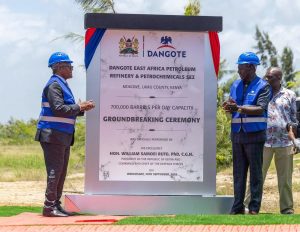
A 700,000-BARREL REGIONAL REFINERY
At 700,000 barrels per day, the proposed facility would be enormous by East African standards and comparable in scale to the initial design capacity of Dangote’s refinery outside Lagos, Nigeria.
The Kenyan plant is expected to produce petrol, diesel, aviation fuel and other refined products. Because Kenya’s own crude production would be far below the refinery’s planned processing capacity, the business model is necessarily regional and international.
Crude could eventually come from East African producers, including Uganda and Kenya, alongside supplies from other producing countries. The refinery’s economics will therefore depend not only on construction but also on reliable crude supply, regional demand, transport costs and global petroleum markets.
GOVERNMENTS OFFERED A STAKE
One of the project’s most notable features is Dangote’s proposal to allow East African governments to participate as shareholders rather than remain only customers.
Regional governments have collectively been offered the opportunity to acquire up to 30 per cent of the refinery. Kenya has been associated with an initial 10 per cent opportunity, and Kenyan officials have indicated that Nairobi could consider a larger position if some other governments do not take up their allocations.
Dangote has also discussed an eventual listing of shares through Nairobi’s securities market. If implemented, that could broaden local and regional ownership, although the final financing and ownership structure will depend on agreements still to be completed.
POWER PLANT COULD CHANGE THE EQUATION
The proposed 1,000MW power component adds another dimension to the investment. Dangote has indicated that the refinery complex could generate electricity using refinery by-products, with a portion potentially available for Kenya’s power system.
Reliable electricity is critical to heavy industry. Supporters of the project argue that power, port access, storage, roads and other infrastructure built around the refinery could encourage additional manufacturers and service companies to locate in the area.
That is why Kenyan officials and project promoters are presenting the refinery as an anchor for a broader industrial ecosystem rather than simply another petroleum facility.
JOBS: BIG PROMISE, IMPORTANT TEST
Ahead of the launch, estimates associated with the project suggested that as many as 60,000 jobs could be generated. Such figures are projections and should not be confused with confirmed permanent employment.
Construction will require large numbers of workers, while indirect opportunities could emerge in transport, accommodation, catering, fabrication, maintenance, security and planning. The longer-term test will be how many skilled, permanent Kenyan jobs remain once the construction phase ends.
For Lamu, where tourism, fishing and traditional coastal livelihoods remain important, the social and economic changes could be substantial.
THE BIGGER AFRICAN INDUSTRIALISATION ARGUMENT
Behind Dangote’s investment is a familiar African economic problem: the continent exports large quantities of raw materials but still imports many of the finished products made from them.
Petroleum is a striking example. Several African countries produce crude oil while consumers across the continent spend heavily on imported petrol, diesel and aviation fuel.
Dangote has repeatedly argued for greater African refining and manufacturing capacity. His Lagos refinery was built around that proposition in West Africa. The Lamu project takes the same industrial strategy to the opposite side of the continent.
If successful, the Kenyan facility could strengthen regional value chains and reduce some dependence on imported finished fuels. Whether it lowers consumer prices will depend on many factors, including taxes, transport, exchange rates, crude costs, competition and government policy.
LAND DISPUTE CLOUDS THE CELEBRATION
The ceremonial groundbreaking does not mean every obstacle has been cleared. A land dispute involving residents who claim ancestral interests in part of the proposed project area is already before the courts.
Residents from the Hindi/Manda Magogoni area have raised questions over ownership, consultation, compulsory acquisition and compensation. The Environment and Land Court has ordered the parties to maintain the status quo over disputed land while the case proceeds.
The residents have said they are not necessarily opposed to development but want their rights and compensation claims addressed. The dispute is expected to return to court in October.
Dangote Group has maintained that the legal proceedings did not prevent the ceremonial launch, although disputes over specific parcels could affect activity on those sites.
ENVIRONMENTAL QUESTIONS IN A SENSITIVE REGION
Environmental concerns are equally significant. Lamu is home to sensitive marine ecosystems, fishing communities and the historic Lamu Old Town, a UNESCO World Heritage Site.
A refinery of this scale would bring increased shipping, storage, industrial activity and associated infrastructure. Environmental groups and local interests are therefore likely to scrutinise pollution controls, marine impacts, emissions, land use and community safeguards.
The project’s long-term credibility will depend not only on its economic performance but also on whether developers and regulators can demonstrate that industrial expansion will not come at an unacceptable environmental or social cost.
A NIGERIAN INDUSTRIAL GIANT MOVES EAST
For Dangote, the Lamu investment represents a major expansion of an industrial model developed largely from Nigeria. His Lagos refinery has already altered petroleum trade in West Africa and drawn international attention to the possibility of building large-scale refining capacity on the continent.
The Kenya project is significant because it represents African private capital crossing regions to build strategic infrastructure in another African economy.
Dangote has spoken of investing tens of billions of dollars across Africa by 2030. Lamu will be one of the clearest tests of whether that ambition can translate into functioning cross-border industrial assets.
RUTO’S INDUSTRIAL BET
For President Ruto’s government, the refinery offers the prospect of investment, jobs, energy infrastructure and a stronger role for Kenya as East Africa’s logistics and industrial hub.
But the promised benefits are not automatic. The project must still secure and deploy enormous amounts of capital, manage land and environmental disputes, obtain regulatory approvals, establish crude-supply arrangements and complete one of the most complex types of industrial facilities on schedule.
Those realities mean Wednesday’s ceremony should be seen as the beginning of the story rather than its conclusion.
FROM CEREMONY TO CONSTRUCTION
The symbolism of the event was nevertheless difficult to miss: a Nigerian businessman stood alongside Kenya’s President and other African leaders to launch a refinery intended to process crude for a predominantly African market.
For years, African governments have spoken about regional integration, local value addition and the need to manufacture more of what the continent consumes. Lamu now offers a practical test of those ambitions at extraordinary scale.
There are court cases to resolve, communities to engage, environmental safeguards to enforce, financing to complete and a vast industrial facility to build.
But if the refinery ultimately reaches its planned 700,000-barrel-a-day capacity, its influence could extend far beyond the Kenyan coast, affecting fuel supply and trade across Kenya, Uganda, Ethiopia, Rwanda and other regional markets.
For now, the ceremonial shovels have entered the ground. The more important test is whether the $16 billion promise made in Lamu can be converted into an operating refinery – and whether the communities and countries around it share meaningfully in the benefits.



